The Digital Nomad’s Accommodation Checklist: What to Look for Before You Book
There is a particular kind of dread that settles in when you unlock the door to a rental you booked three weeks ago, hopeful and jet-lagged, only to find the Wi-Fi router blinking sullenly in the corner and a single hard chair pulled up to a wobbly kitchen table. The photos looked perfect. The reviews mentioned nothing about the construction site next door or the fact that the nearest café closes at four. And now you have a client call in ninety minutes and nowhere comfortable to take it.
For most travellers, a place to sleep is enough. For those of us who work from wherever we happen to be standing, accommodation is also an office, a sanctuary, and the invisible infrastructure that holds an entire livelihood together. A bad booking doesn't just ruin a holiday — it costs deadlines, sleep, and sometimes money you can ill afford to lose. The stakes are quietly higher, and the checklist longer, than the average booking site would have you believe.
What follows is the accommodation checklist worth internalising before you ever tap that confirm button. Not a rigid form to fill out, but a way of reading a listing — of learning to see past the wide-angle lens and the flattering morning light to the reality of living and working somewhere for a week, a month, or longer.
Start With the Connection, Not the Cushions
It is tempting to fall in love with a listing for its balcony, its exposed brick, its dreamy tiled bathroom. But before any of that seduces you, find the internet. A remote worker's first and most non-negotiable question is always the same: can I do my job from here reliably, every single day, regardless of weather or time of day? A photogenic apartment with unstable connectivity is, functionally, a very expensive holiday flat you cannot use for work.
Listings that advertise "Wi-Fi" without numbers are telling you nothing. Message the host and ask for a specific download and upload speed, ideally with a screenshot of a recent speed test taken inside the property. Anything below 25 Mbps download makes video calls fragile; upload speed matters just as much if you send large files or stream your own video, and it is the figure hosts most often forget to mention. Ask whether the connection is fibre, cable, or a mobile hotspot — the latter can throttle or cap without warning. And ask the quietly crucial question: is there a backup? A neighbouring café, a coworking space within walking distance, or a local SIM with generous data can be the difference between a missed deadline and a mild inconvenience.
Pay attention, too, to power. Frequent outages are a reality in many beautiful and affordable destinations, and they rarely appear in listing descriptions. A generator, an inverter, or even the host's honest acknowledgement that the power dips for an hour most afternoons lets you plan around it rather than be ambushed by it. The travellers who thrive long-term are the ones who treat connectivity as their primary filter and let the aesthetics come second.
Interrogate the Workspace Before You Arrive
Interrogate the Workspace Before You Arrive
Essential workspace features compared across typical accommodation types for remote workers.
| Feature | Apartment | Coworking Space | Furnished House |
|---|---|---|---|
| Dedicated desk | Yes | Yes | Yes |
| Ergonomic chair | Varies | Yes | Sometimes |
| Backup power supply | Not included | Yes | Sometimes |
| Quiet environment | All day | Limited hours | All day |
| Meeting-ready setup | Partial | Full access | Full access |
| Best for focus work | Recommended | Occasional | Recommended |
Illustrative figures — composed for shape, not sourced
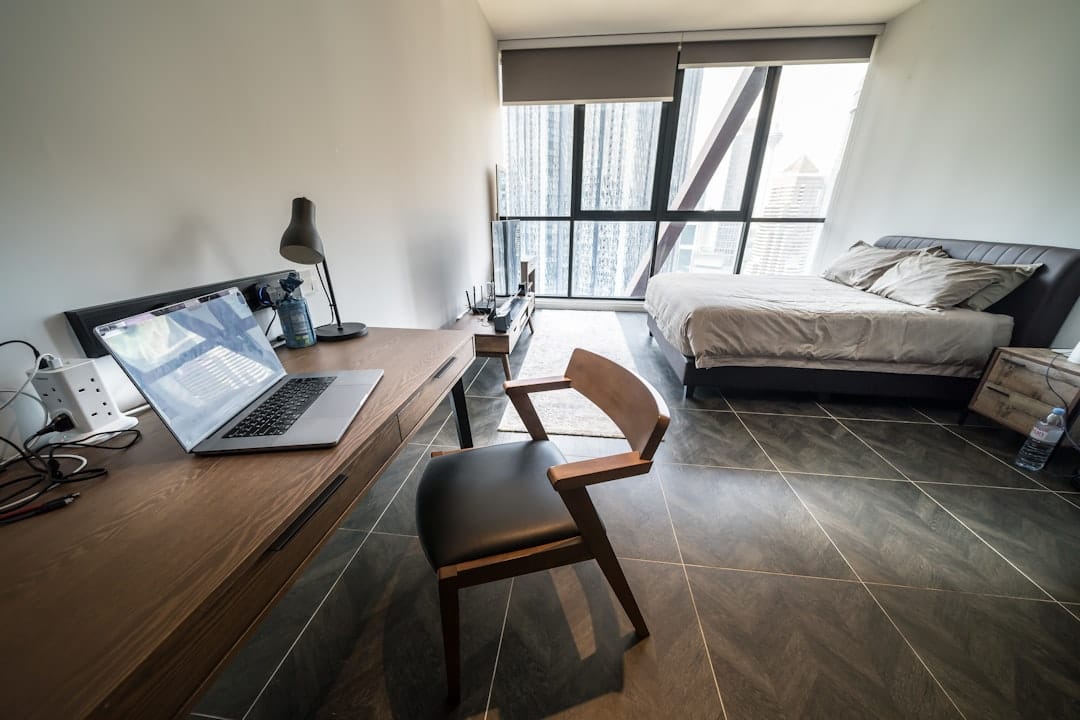
Somewhere in every listing's gallery there is usually one photo that quietly reveals the truth about working there. Look for the desk. If you cannot find a proper table and a supportive chair anywhere in the images, assume they do not exist. A surprising number of otherwise lovely rentals expect you to work hunched over a coffee table or perched on a bed, and eight hours a day in that position will wreck your back and your mood within a week.
Ask directly: is there a dedicated desk and a chair with back support? Where is it positioned, and what is the natural light like at the hours you actually work? A desk facing a bright window can turn every afternoon video call into a silhouette; a desk in a windowless corner can drain you by mid-morning. If the space is thin on proper furniture, you can compensate with a few packable tools — a laptop stand, a compact keyboard, and a lightweight lumbar cushion transform almost any surface into a workable station. It is worth understanding how much difference the right setup makes, and our guide to ergonomic home office accessories for remote workers is a good place to start building your travel kit.
Think, too, about acoustics and privacy. If you are travelling with someone or sharing space, is there a door you can close for calls? Are the walls thin enough that a neighbour's television will bleed into your meetings? A place that photographs as open and airy can be an acoustic nightmare when two people are trying to work and rest in the same room. The most successful long stays tend to have a psychological boundary between where you work and where you unwind — even if that boundary is just a well-placed desk in a quiet corner rather than a separate room. If you want to go deeper, the principles in our piece on creating a distraction-free workspace translate surprisingly well to temporary rentals.
Enjoying this? Get more like it.
Weekly picks for remote workers and digital nomads — tools, destinations, and honest takes, straight to your inbox.
Subscribe free →
Read the Location Like a Local, Not a Tourist
A tourist wants to be in the middle of everything. A remote worker often wants something subtler: a neighbourhood that is alive enough to be interesting but calm enough to concentrate in. Before booking, drop the address into a map and explore the surrounding streets in satellite and street view. How far is the nearest grocery store, pharmacy, or café you might use as a backup office? Is there a coworking space within a comfortable walk? What sits immediately next door — a quiet courtyard, or a nightclub that comes alive at midnight?
Time zones deserve a place on this checklist too, and they are easy to overlook when you are dazzled by a destination. If your clients or colleagues sit in a wildly different time zone, the charming apartment eight hours ahead may force you into midnight calls and a permanently jet-lagged routine. Sometimes the smart choice is a slightly less glamorous destination that keeps your working hours humane. This is one reason so many location-independent workers gravitate toward the kind of relaxed, well-connected bases we cover in our guide to slow travel cities for digital nomads on a budget — places built for staying, not just passing through.
Consider the rhythm of the street across a full day and week. A market square that hums pleasantly on a Tuesday afternoon might become a bottleneck of noise and crowds on a Saturday night. If you can, look for reviews that mention noise specifically, and search for the word itself within the review section — travellers who were disturbed almost always say so. The location that lets you close your laptop and step straight into a good coffee, a green space, and an evening walk will do more for your wellbeing over a month than any single interior feature.
Scrutinise the Fine Print, the Costs, and the Host
The nightly rate is rarely the real price. Cleaning fees, service charges, city taxes, and utility surcharges can inflate a booking by a third or more, and some hosts charge separately for air conditioning or heating by the unit — a nasty surprise in a heatwave or a cold snap. For longer stays, ask whether a weekly or monthly discount applies; many hosts offer substantial reductions that never appear until you extend the dates, and negotiating a month-long rate directly can save a meaningful amount. Factor in the true monthly cost, including the local transport and eating habits the location will encourage, before you decide something is affordable.
Read the cancellation policy as though you will need it, because sometimes you will. Flights get changed, visas get delayed, and plans shift in ways that are hard to predict from the other side of the world. A flexible or moderate policy buys you room to adapt; a strict one can trap a large deposit if anything goes wrong. Pay attention to check-in logistics as well — self check-in with a lockbox is a gift when you arrive at two in the morning, while a host who insists on meeting you in person during business hours can leave you stranded after a delayed flight.
Finally, judge the host by how they communicate before you book. A response that is prompt, specific, and warm tends to predict a smooth stay; vague or slow replies to reasonable questions are a quiet warning. Ask something that requires a real answer — the true upload speed, the noise situation, the backup plan for a power cut — and notice not just what they say but how they say it. A great host is often the single biggest factor in whether a stay feels supported or precarious, and shared spaces designed specifically for remote workers can remove much of this guesswork; our roundup of top co-living spaces for affordable digital nomad housing is worth a look if you value community and built-in reliability over a private flat.
Trust the Details That Photos Hide
Some of the most important factors in a stay never make it into a single photograph. Water pressure, hot water reliability, the presence or absence of mosquito screens, whether the kitchen has anything more than a kettle and a microwave — these are the quiet variables that shape daily life. A month of cold showers or a room that fills with insects the moment you open a window will erode your patience far faster than a small desk ever could. If these things matter to you, and after a long enough time on the road they always start to, ask about them explicitly.
Read reviews with an editor's eye. Skim past the five-star raptures and hunt for the three- and four-star entries, where honest travellers tend to bury the useful caveats: the stairs with no lift, the street noise on weekends, the heating that never quite reached the bedroom. A recurring complaint across several reviews is almost always real, no matter how the host frames it in their reply. Look at the dates, too — a flurry of glowing reviews followed by a long silence, or a run of recent disappointments, tells its own story about whether standards are rising or slipping.
Above all, protect your energy, not just your logistics. The right accommodation supports the rhythm you need to sustain both work and life on the road, and the wrong one quietly taxes you until burnout creeps in. If you have felt that drain before, our guide to mastering digital nomad burnout is a reminder that where you stay is as much a wellness decision as a practical one.
None of this needs to become a joyless spreadsheet. Over time, reading a listing well becomes instinct — you learn to sense the wobbly desk in a photo, to catch the euphemism in a description, to hear the truth beneath a host's cheerful reply. The checklist is really just a way of asking one honest question before you commit: can I actually live and work here, at my best, for as long as I intend to stay?
Get that right and the rest of the trip has room to be wonderful. The desk holds up, the connection stays steady, the neighbourhood welcomes you, and the small daily frictions never get the chance to accumulate. That is the quiet luxury of a well-chosen base — the freedom to stop thinking about where you are and simply get on with the work, and the living, you came all this way to do.