What is the 3 3 3 rule for travel packing?
There is a particular kind of dread that settles in the night before a trip, when the suitcase yawns open on the bed and the wardrobe seems to have multiplied in your mind. You stand there holding two nearly identical shirts, paralysed by the question of whether you'll want the lighter one on Thursday or the slightly warmer one on Friday. The result is almost always the same: you overpack, then drag the consequences through three airports and a cobblestoned old town that was never designed for wheeled luggage.
The 3 3 3 rule for travel packing exists to dissolve exactly that paralysis. It is a deceptively simple formula that strips your packing list down to a manageable, almost meditative count: three tops, three bottoms, three pairs of shoes — and, depending on which version you follow, three accessories, three layers, or three days of mixing and matching. It is the kind of constraint that feels too restrictive until you actually try it, at which point it tends to feel like someone quietly handed you back your weekends.
For anyone who works while they travel — moving between co-working spaces, café tables and the occasional client video call — this kind of discipline is not a party trick. It is the difference between travelling light enough to live well and hauling a life you don't use. Let's walk through what the rule actually means, how to apply it, where people get it wrong, and how to bend it to fit a life lived out of a carry-on.
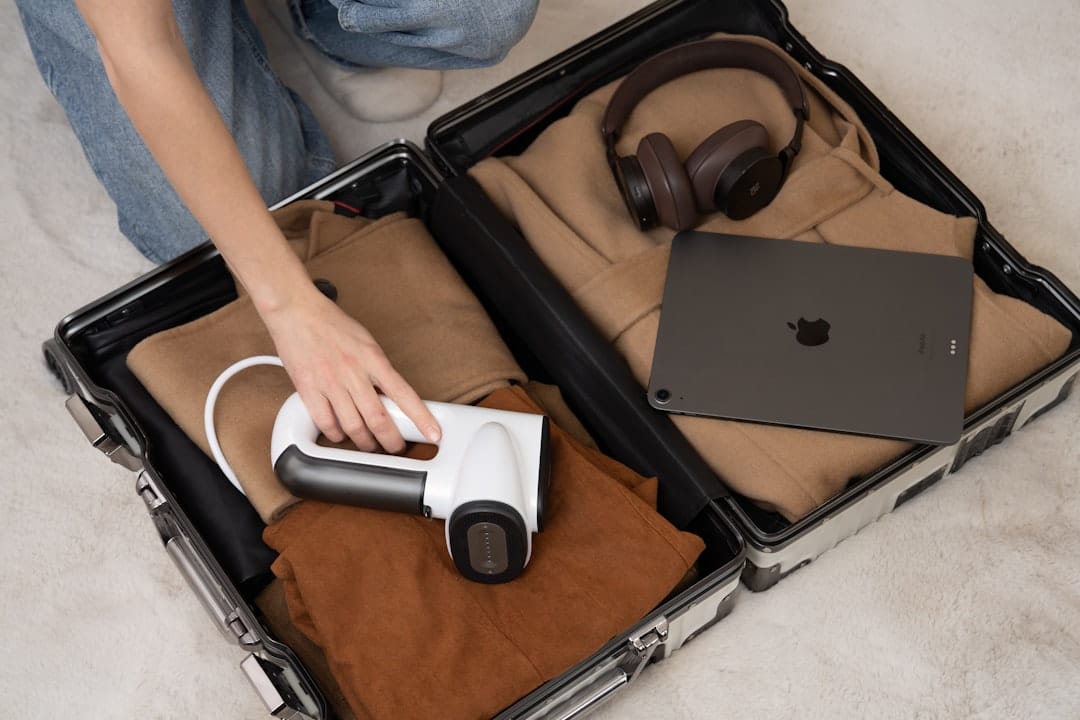
What the 3 3 3 Rule Actually Means
At its core, the 3 3 3 rule is a packing capsule built around the number three. The most common interpretation asks you to pack three tops, three bottoms, and three pairs of shoes for a trip. That's it. From those nine items you build every outfit you'll wear, trusting that a well-chosen mix will stretch far further than the cluttered wardrobe most people drag along. The maths is quietly persuasive: three tops and three bottoms alone yield nine distinct combinations, which is more than enough to keep you looking deliberate rather than dishevelled.
There are a few competing versions floating around, and it's worth knowing them so you can pick the one that suits your trip. Some travellers read it as three tops, three bottoms and three accessories — scarves, a belt, a hat — that change the register of an outfit without adding bulk. Others treat it as a challenge to wear only three outfits across three days before doing a small load of laundry, repeating the cycle indefinitely. There's even a version aimed at minimalists that limits you to three of everything, full stop: three shirts, three pairs of socks, three pairs of underwear, and a hard stop at the number.
The exact wording matters less than the underlying philosophy, which is this: a deliberate constraint forces better decisions. When you can only bring three tops, you stop packing the maybe-shirt and start packing the shirt you actually love and reach for. The rule isn't really about the number three. It's about replacing the vague anxiety of "what if I need it" with the clarity of "these are the things I will use."
How to Build Your 3 3 3 Capsule Step by Step
Start with a colour spine. Before you choose a single garment, pick two neutrals that will anchor everything — say, navy and stone, or black and olive — plus one accent that makes you feel like yourself. The discipline of a shared palette is what makes nine items behave like a much larger wardrobe, because every top works with every bottom and nothing clashes. This is the single most important step, and it's the one most people skip in their rush to start folding.
Next, choose your three of each by role rather than by mood. Your three tops should cover the spectrum of your days: one relaxed (a soft tee for travel and downtime), one smart-casual (a button-up or knit that reads well on a video call), and one in between that flexes either way. Do the same with bottoms — perhaps a pair of versatile trousers, something more rugged for walking or hiking, and one option that handles warm afternoons. For shoes, the holy trinity is usually one comfortable walking shoe, one slightly dressed-up pair, and one for the unexpected: sandals, trainers for a run, or weather-proof boots if your destination demands them. If you're settling somewhere for a few weeks, your packing strategy connects naturally to where you'll base yourself, so it's worth reading up on essential accommodation tips for remote work travel before you commit to a base.
Finally, lay everything out and run the combinations in your head — or better, on the bed. Pair top one with each bottom, then top two, then top three, and look honestly at whether each combination is something you'd actually wear out the door. If a garment only works with one other item, it's a passenger, not a crew member, and it should be swapped for something more sociable. This dress-rehearsal stage takes ten minutes and saves you from discovering, three time zones away, that your favourite shirt fights with everything you brought.
Enjoying this? Get more like it.
Weekly picks for remote workers and digital nomads — tools, destinations, and honest takes, straight to your inbox.
Subscribe free →
The Mistakes That Quietly Undermine the Rule
The Mistakes That Quietly Undermine the Rule
Common packing mistakes and how to avoid them when following the 3 3 3 rule.
| Mistake | Impact | Solution |
|---|---|---|
| Ignoring colour coordination | Limited outfit combinations | Choose neutral base colours |
| Over-packing 'just in case' | Exceeds luggage limits | Stick to essentials only |
| Forgetting destination climate | Unsuitable clothing worn | Research weather in advance |
| Selecting low-quality fabrics | Quick wear and tear | Invest in durable pieces |
The most common failure isn't bringing too much — it's bringing the wrong three. People apply the rule faithfully to the count but ignore the colour spine, ending up with three tops in three clashing tones that refuse to mix. The result is technically minimalist and practically useless, because you've recreated the same outfit problem in a smaller bag. The number means nothing without cohesion behind it; three well-matched items beat nine random ones every time.
Another quiet sabotage is forgetting that the 3 3 3 rule is really a laundry rule in disguise. The whole system depends on washing clothes regularly — usually every few days — rather than wearing a fresh item every single day. Travellers who don't plan for laundry find themselves stretching three tops across a fortnight and feeling grim about it by day five. Before you trim your packing list this aggressively, confirm that your accommodation has a washing machine, a nearby launderette, or at least a sink and a packet of travel detergent. The capsule and the laundry plan are two halves of the same idea.
The third mistake is treating the rule as a religion rather than a framework. The 3 3 3 structure governs your clothing capsule — it was never meant to count your laptop, your chargers, your noise-cancelling headphones, or the one good jacket that makes a rainy day bearable. If you find yourself agonising over whether a packable rain shell breaks the rule, you've misunderstood it. Outerwear, work gear and weather-specific essentials sit outside the nine. The point is to simplify the part of packing that genuinely spirals, not to leave you cold and unequipped in the name of purity.
Adapting 3 3 3 for Remote Work and Slow Travel
If you work as you travel, your capsule has a job to do that a holidaymaker's doesn't: it has to survive a camera. At least one of your three tops should be a "call-ready" piece — a colour that flatters on screen, a fabric that doesn't crease into a roadmap, a neckline that looks intentional above the frame of a webcam. Build the rest of the capsule around it so that on any given morning, dressing for a client meeting is a thirty-second decision rather than a small crisis. This is where the rule earns its keep for nomads: it makes you look put-together with almost no daily effort, which is exactly the mental bandwidth you want to save for actual work.
Slow travel changes the calculus in your favour. When you're staying in one place for weeks rather than days — settling into a flat, a co-living house, or a neighbourhood café that learns your order — the laundry problem all but vanishes, and a tight nine-item capsule becomes genuinely comfortable. You wash on a rhythm, you rotate your three-by-three, and you discover that you simply don't miss the suitcase full of options. If anything, the constraint sharpens your sense of place, because you're not living out of luggage; you're living somewhere. Many of the best destinations for this kind of unhurried month-long stay are surprisingly affordable, and a little research into slow travel cities for digital nomads on a budget pays off long before you start folding shirts.
Climate is the one variable that bends the rule hardest. A 3 3 3 capsule for a warm coastal stint looks nothing like one for a mountain winter, so anchor your nine to the season you're actually entering, not the one you left. The trick for shifting climates is layering: three thin tops that can be doubled up under a single packable jacket will see you through a startling range of temperatures without expanding the count. Wool and technical fabrics do a lot of heavy lifting here, drying overnight and resisting odour, which lets a small capsule punch far above its weight on a long, varied trip.
Tools and Habits That Make It Stick
Tools and Habits That Make It Stick
Essential tools and habits to maintain your 3 3 3 packing discipline over time.
| Habit or Tool | Digital | Physical | Ease of Use |
|---|---|---|---|
| Packing list checklist | Yes | Yes | High |
| Outfit combination photos | Yes | No | High |
| Colour-coded garment tags | No | Yes | Medium |
| Weekly capsule review | Yes | Yes | Medium |
Packing cubes are the unglamorous hero of the 3 3 3 method. One cube for tops, one for bottoms, and a slim pouch for accessories turns the abstract rule into a physical system you can see at a glance. When everything has a designated cube and the cube is full, you've hit your limit — no agonising, no creep. Compression cubes go a step further, squeezing your nine items into a footprint that leaves genuine room for the things that actually justify their weight: a slim laptop stand, a folding keyboard, the gear that makes working from anywhere bearable.
A reusable packing list is the habit that turns one good trip into a repeatable practice. Keep a simple note on your phone listing your tried-and-tested nine, your work kit, and your toiletries, and refine it after every journey — striking the thing you never wore, promoting the thing you wished you'd had. Over a few trips this list becomes a kind of personal packing intelligence, and the night-before dread evaporates because the decisions are already made. Pair it with a small bottle of travel wash and a flat sink stopper, and your laundry plan travels with you in a sandwich-bag-sized footprint.
The deeper habit, though, is learning to trust the constraint. The first time you commit to nine items you'll feel an itch to smuggle in a tenth, a contingency, a just-in-case. Resist it once and you'll see the rule deliver: you wore everything, you washed on schedule, and you walked through every train station without breaking a sweat. After that, the lightness becomes self-reinforcing, and a sprawling suitcase starts to look like the genuinely strange choice it always was.
The 3 3 3 rule endures because it solves a real problem with almost no complexity. It doesn't ask you to buy a special bag or follow a twelve-step regime; it just asks you to pick three tops, three bottoms and three pairs of shoes, hold them to a shared palette, and plan to do a little laundry. In exchange it hands back the part of travel that overpacking quietly steals — the freedom to move easily, to say yes to the spontaneous detour, to carry your whole life up a flight of stairs without resenting it.
Try it on your next trip, even as an experiment. Build your nine, run the combinations, and notice how rarely you miss the things you left behind. The odds are good that you'll arrive home wondering why you ever travelled any other way — and that the next packing night will pass without a single moment of dread.