Creating a Minimalist Home Office: Enhancing Focus for Digital Nomads
There is a particular kind of morning that repeats itself across cities and time zones when you work from wherever you happen to land. The light shifts through an unfamiliar window, a kettle you bought secondhand begins to hiss, and you sit down at a desk that is not really a desk — maybe a kitchen table in Lisbon, a fold-out surface in a co-living dorm in Medellín, a slab of laminate in a Chiang Mai apartment. And in that moment, before the first message pings and the day gains its momentum, you feel it: either the calm of a space that lets you think, or the low static of clutter that pulls your attention in a dozen directions at once.
Minimalism, for the location-independent worker, is not an aesthetic borrowed from glossy interior magazines. It is a survival strategy. When your entire life fits into a carry-on and a backpack, every object you carry and every surface you arrange has to earn its place. A minimalist home office for digital nomads is less about owning white furniture and more about engineering a portable pocket of focus — one you can assemble in twenty minutes in a rented room and dismantle just as fast when the next visa runs out.
This is the paradox worth exploring. The less you bring, the more clearly you can work. Constraint, handled well, becomes a gift. Over the next few sections we will walk through what a truly portable minimalist workspace looks like, how to build one from almost nothing, the mistakes that quietly sabotage focus, and how to adapt your setup to the wildly different rooms you will find yourself in as you move across the world.
Why Less Really Does Mean More Focus
The brain treats visual clutter the way it treats background noise: as a stream of competing signals, each one asking for a sliver of attention. A desk piled with adapters, receipts, half-empty water bottles and a tangle of cables is not neutral. It is a quiet negotiation happening beneath conscious thought, and it drains the very reserves of concentration you need for deep, well-paid work. When you clear the surface, you are not tidying for the sake of tidiness — you are removing rivals for your focus.
For the nomad, there is a second, more practical layer. Every object you own is something you must pack, protect, and eventually move through an airport. Minimalism compounds in your favour: fewer things to lose, fewer things to break, fewer decisions to make each morning. The mental lightness of knowing exactly where everything lives — because there is so little of it — translates directly into the calm required to sit down and produce good work in an unfamiliar place.
There is also the matter of consistency. A rich, complicated home office anchored to one apartment cannot travel with you, which means your working conditions reset every time you relocate. A pared-down kit, by contrast, is repeatable. The same laptop stand, the same keyboard, the same small ritual of setting up — that repetition becomes a psychological cue that tells your mind it is time to work, regardless of whether the window looks out over rooftops in Porto or palm trees in Canggu.
Building Your Portable Workspace From Almost Nothing
Building Your Portable Workspace From Almost Nothing
Essential vs. optional office equipment for nomads, with portability and focus impact ratings.
| Equipment | Essential | Weight | Focus Impact |
|---|---|---|---|
| Laptop | Yes | 1.5–2.5 kg | Critical |
| External Monitor | No | 3–5 kg | High |
| Ergonomic Chair | No | 5–8 kg | Moderate |
| Desk Lamp | No | 0.5 kg | Moderate |
| Noise-Cancelling Headphones | No | 0.2 kg | High |
Illustrative figures — composed for shape, not sourced
Start with the surface. You rarely control the room you arrive in, so the goal is to make any flat surface work. A collapsible laptop stand that folds to the thickness of a paperback lifts your screen to eye level and prevents the neck strain that turns an eight-hour workday into an ordeal. Pair it with a slim wireless keyboard and a compact mouse, and you have transformed a hostel table into an ergonomic station in under a minute. These three items — stand, keyboard, mouse — are the load-bearing pillars of a portable setup, and they weigh almost nothing.
Next comes the sensory layer, because focus is not only visual. A good pair of noise-cancelling headphones does more than block a crying baby on a plane; it draws a boundary around your attention in shared and unpredictable environments. When you are working from a co-living lounge or a café with an unreliable soundscape, that boundary is the difference between shallow busywork and genuine concentration. If you are weighing up communal setups, our guide to the top co-living spaces for affordable digital nomad housing is a useful place to understand what kind of work environments you will actually be plugging into.
Finally, tame the cables. A single small pouch that holds your charger, a short cable, and a universal travel adapter keeps the chaos contained and means setup and teardown become a ritual rather than a scavenger hunt. Resist the temptation to carry backups of backups. One good multi-port charger can replace three separate bricks. The discipline of choosing multipurpose items over specialised ones is where the real minimalism lives — not in throwing things away, but in refusing to acquire them in the first place.
Enjoying this? Get more like it.
Weekly picks for remote workers and digital nomads — tools, destinations, and honest takes, straight to your inbox.
Subscribe free →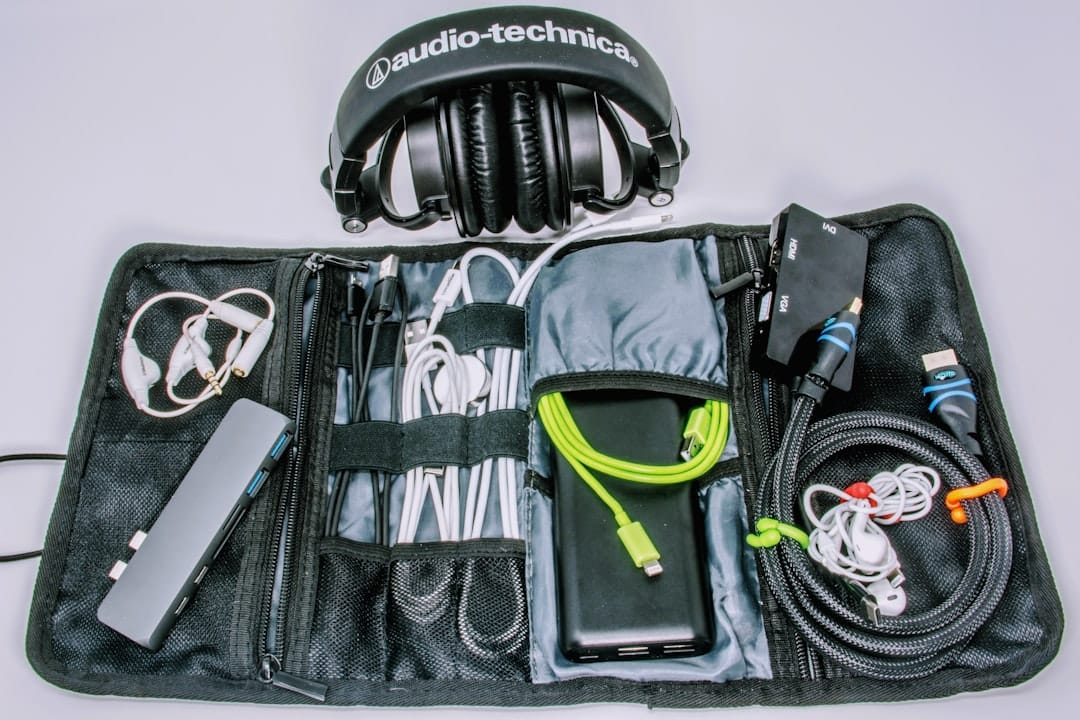
The Mistakes That Quietly Sabotage Your Focus
The most common error is confusing minimalism with deprivation. Some travellers strip their setup so bare that they work hunched over a laptop on a bed for months, and then wonder why their backs ache and their afternoons dissolve into fatigue. Minimalism is not about owning the fewest possible objects; it is about owning the right ones. A single ergonomic upgrade that protects your body will do more for sustained focus than a dozen motivational trinkets ever could. Cut ruthlessly, but never cut the things that keep you healthy enough to work.
The second trap is ignoring the environment beyond the desk. You can arrange a flawless minimalist station and still lose the morning if the room around it is visually loud or badly lit. Colour, in particular, has a measurable effect on mood and productivity — worth reading up on in our piece on home office colour psychology before you next choose which corner of an apartment to claim as your workspace. Face a window if you can, put the loudest visual clutter of the room behind you, and let natural light do the work that an expensive lamp cannot.
The third and subtlest mistake is digital clutter, which follows you regardless of how spare your physical space becomes. A desktop littered with files, forty open browser tabs, and a phone buzzing every few minutes recreates the exact chaos you worked so hard to remove from the table. Treat your digital environment with the same discipline: close what you are not using, silence non-essential notifications, and keep the screen in front of you as clean as the surface beneath it. Physical and digital minimalism reinforce each other, and neglecting one undermines the other. Burnout often creeps in through this gap, which is why building calm habits early matters — something we explore in our guide to mastering digital nomad burnout.
Adapting Your Setup to Every Room You Land In
No two rooms are the same, and the great skill of the location-independent worker is reading a space quickly and adapting. In a cramped studio, the challenge is separation — carving a psychological line between where you work and where you rest, even if they are the same square metre. Here a portable setup earns its keep. Assemble it in the morning as a signal that work has begun; pack it away in the evening to reclaim the room as a home. That physical ritual does the work that a closed office door does for someone with a permanent desk.
In hotter climates and older buildings, air and light dictate everything. A room that traps heat by midday is a room you will abandon by lunch, so pay attention to airflow and shade when you choose your corner. In cooler cities with long, dark winters, the opposite problem appears, and a small portable light with warm output can rescue the short afternoons. The point is not to fight the environment but to work with it, choosing your hours and your spot to match the rhythm of the place you are in. Slow travel makes this easier — staying longer in fewer places, as we discuss in our roundup of slow travel cities for digital nomads on a budget, gives your minimalist setup time to become a genuine routine rather than a nightly improvisation.
Then there are the shared spaces — co-working floors, café corners, communal kitchens at co-living houses. Here minimalism is partly about courtesy and partly about mobility. A setup that assembles and disappears in under a minute means you can claim a good seat when one opens up and vacate it graciously when you are done. The nomads who thrive in these environments are the ones whose entire office lives in a slim sleeve they can sling over a shoulder, ready to migrate to the quiet table by the window the moment it frees up.
The Habits That Keep a Minimalist Space Minimal
The Habits That Keep a Minimalist Space Minimal
Daily and weekly habits that maintain focus and minimize clutter in nomadic workspaces.
| Habit | Frequency | Time Required | Focus Benefit |
|---|---|---|---|
| Clear desk before leaving | Daily | 5 mins | High |
| Digital file cleanup | Weekly | 15 mins | Moderate |
| Assess unused items | Monthly | 20 mins | High |
| Desk decoration rotation | Seasonal | 30 mins | Low |
Illustrative figures — composed for shape, not sourced
A minimalist workspace is not a state you achieve once; it is a practice you maintain. Clutter accumulates the way sediment settles — slowly, invisibly, until one day the surface is buried again. The simplest defence is a one-in, one-out rule: every new object you acquire must replace something you already carry. This single habit prevents the gradual bloat that turns a lean kit into an overweight backpack over the course of a year on the road.
Build a short end-of-day reset into your routine. Two minutes of clearing the surface, coiling the cable, and closing the laptop turns tomorrow's setup into a clean start rather than a confrontation with yesterday's mess. This is the same principle chefs use when they clean as they cook — the small, consistent effort prevents the large, demoralising one. Over weeks, that reset becomes automatic, and the calm it produces stops feeling like discipline and starts feeling like home.
Finally, review your kit every few months with honest eyes. Experienced travellers find that the objects they were certain they needed at the start of a journey are often the ones gathering dust by the end. If something has not earned its place in a season, it probably will not in the next. Letting go is uncomfortable, but each thing you release makes the whole system lighter, faster, and quieter — and it is that quiet, more than any single gadget, that lets you sit down and do your best work anywhere in the world.
A minimalist home office for digital nomads is ultimately an act of trust in your own attention. By stripping away the things that compete for it, you make room for the work that funds this whole way of living. The magic is not in the stand or the headphones or the perfectly coiled cable; it is in the clarity those choices create — the ability to arrive in a strange room, set up in twenty minutes, and slip into focus as if you had worked there for years.
So keep it light. Choose the right few things, tend them like a small garden, and let the empty space around your laptop become the quietest, most productive corner of wherever you happen to call home this month. The world is wide and your desk is small — and that, it turns out, is exactly the point.