4 Travel Hacks for Packing Light: Minimalist Tips for a Carry-On
There is a particular kind of freedom that arrives the moment you stride past the baggage carousel without slowing down. While everyone else clusters around the slowly turning belt, watching identical black suitcases tumble out one after another, you walk straight through the doors and into the warm chaos of a new city. No waiting. No lost-luggage anxiety. No twenty-minute wrestling match to wedge an oversized case into the boot of a taxi. Just you, your single bag, and the open afternoon.
Carry-on only travel has quietly become the signature move of the seasoned remote worker. It is not about deprivation or some performative show of austerity. It is about momentum — the ability to move between cities, co-living spaces, and coworking cafes without the friction of cargo. When your whole life fits into a bag you can lift overhead, you stop being a tourist hauling possessions and start being someone who genuinely lives wherever they land.
But packing light is a skill, not a personality trait. It is learned through a handful of deliberate decisions made before you ever zip the bag shut. What follows are four travel hacks — and the thinking behind them — that turn the daunting idea of carry-on only travel packing into something almost effortless. Master these, and you may never check a bag again.
Hack One: Build a Capsule Wardrobe Around a Single Palette
The single biggest source of overpacking is not gadgets or toiletries — it is clothing. People pack for the person they imagine they might be on a given trip: the one who attends a spontaneous gala, the one who suddenly takes up trail running, the one who needs three different jackets for three imagined weather scenarios. The fix is to pack instead for the life you actually live, and to do it within a tightly controlled colour palette.
Choose two or three base colours that flatter you and quietly agree with one another — say, navy, olive, and a warm grey, with white and black as neutral anchors. When every item shares a palette, everything becomes interchangeable. A pair of dark trousers works equally well with a plain tee in a quiet cafe or a collared shirt at a client dinner. Five tops and three bottoms suddenly yield more outfits than you could possibly wear in a fortnight. The maths of mixing and matching is far more generous than most travellers realise, and it only works when nothing clashes.
Lean heavily on natural, fast-drying fabrics — merino wool, technical blends, linen — that resist odour and can be rinsed in a hostel sink and dried overnight. Merino in particular is a quiet miracle: a single shirt can be worn for days without complaint, which means you pack fewer of them. The goal is a wardrobe where every piece earns its place by working hard and playing well with everything else. If an item only pairs with one other thing, it stays home.
Hack Two: Master the Roll, the Cube, and the Art of Compression
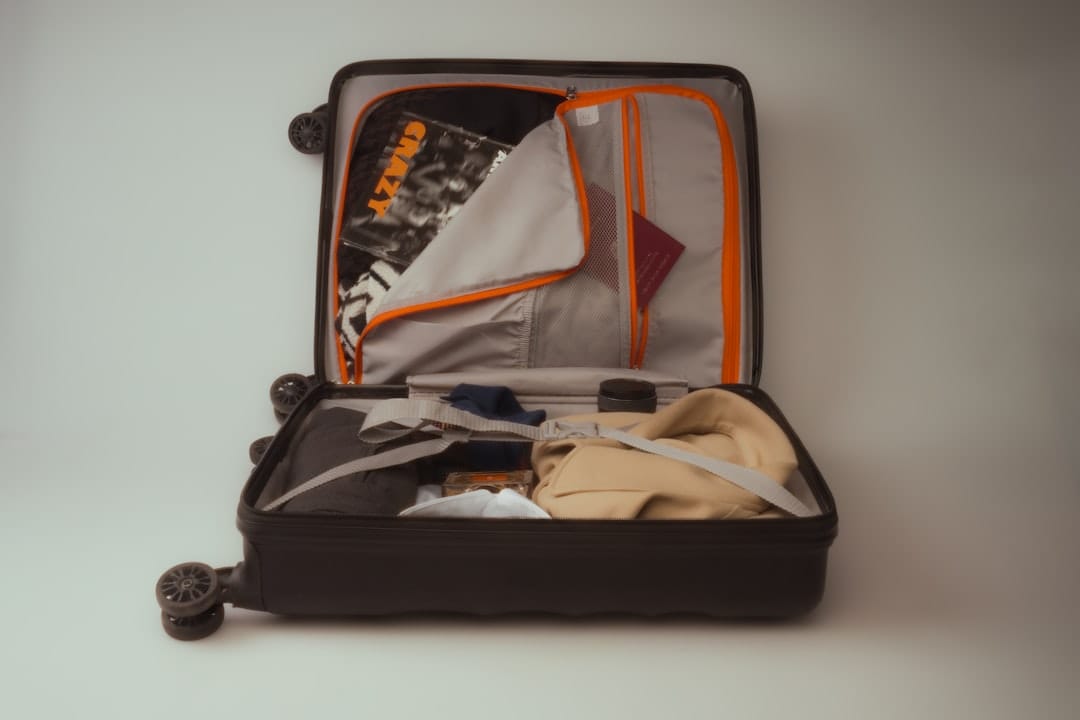
How you pack matters almost as much as what you pack. The eternal debate between rolling and folding has a clear winner for carry-on travellers: rolling. Rolled garments compress tighter, resist creasing, and tessellate neatly into the corners of an awkwardly shaped bag. A tightly rolled merino tee takes up roughly half the space of the same shirt folded flat, and you can wedge socks and underwear into the cylindrical gaps that rolling inevitably creates.
Packing cubes turn a chaotic bag into a filing system. Assign one cube to tops, one to bottoms, one to underwear and socks, and a slim one to electronics cables and chargers. When you arrive somewhere new and live out of your bag for a week, you simply pull out the relevant cube rather than excavating the entire thing every morning. Compression cubes take this a step further, using a second zip to squeeze the air out of bulkier items like a packable down jacket. The difference in volume is genuinely startling the first time you try it.
There is a discipline here that bleeds into the rest of remote work life — a kind of intentional minimalism that pairs naturally with the broader philosophy laid out in the digital nomad manifesto. Owning less, carrying less, and committing only to the essentials is not a packing trick so much as a mindset, and it tends to follow you off the plane and into how you work, where you stay, and what you choose to spend on.
Enjoying this? Get more like it.
Weekly picks for remote workers and digital nomads — tools, destinations, and honest takes, straight to your inbox.
Subscribe free →
Hack Three: Shrink Your Tech and Toiletries to the Bone
Hack Three: Shrink Your Tech and Toiletries to the Bone
Essential tech and toiletry items for minimalist travelers with weight and multi-use recommendations.
| Item | Weight (g) | Multi-Use | Essential |
|---|---|---|---|
| Phone + Cable | 150–200g | Yes | Yes |
| Portable Charger | 100–150g | Yes | Yes |
| Microfiber Towel | 50–80g | Yes | Yes |
| 2-in-1 Shampoo | 40–60g | Yes | Yes |
| Sunscreen Stick | 30–50g | Partial | Yes |
| Laptop/Tablet | 500–1000g | Partial | On request |
For remote workers, the tech kit is often the heaviest and most precious part of the bag. The temptation is to bring everything — a laptop, a tablet, a backup hard drive, a tangle of charging bricks, an HDMI cable just in case. Resist it. Consolidate to a single universal charger with multiple ports, replace your tangle of cables with a slim cable organiser, and ask hard questions of every device. Do you genuinely use that tablet on the road, or does it just ride along feeling guilty? A capable laptop and a good phone cover the vast majority of remote work, and a compact set of reliable tools beats a heavy pile of maybes. There is a solid case for curating a lean kit of must-have tools for a seamless remote work routine rather than a sprawling one.
Toiletries are where bags balloon for no good reason. Liquids are heavy, regulated, and almost universally available wherever you are going. Switch to solid alternatives wherever you can: shampoo bars, solid conditioner, toothpaste tabs, a bar of soap in a vented tin. Solids skip the liquids limit entirely, never leak across your clothes at altitude, and last far longer than their bottled cousins. For the liquids you genuinely cannot replace, decant them into small reusable bottles rather than carting full-size containers you will never empty.
The deeper principle is this: anything cheap, light, and widely available at your destination does not need to travel with you. Sunscreen, a razor, a cheap umbrella — these are all purchasable in minutes almost anywhere on earth. Reserve your precious carry-on space for the things that are genuinely hard to replace: prescription medication, the specific adapter your laptop needs, the comfortable shoes that took years to break in. Everything else is just weight you have chosen to carry out of habit.
Hack Four: Plan Around Laundry and Long Stays, Not Worst-Case Scenarios
The mathematics of overpacking is driven almost entirely by fear. People pack fourteen days of clothing for a fourteen-day trip because they cannot imagine doing laundry along the way. But laundry exists everywhere, and embracing it is the single most liberating shift in your packing logic. Pack for roughly a week, plan to wash your clothes once or twice, and the size of your bag shrinks dramatically regardless of whether your trip lasts ten days or ten months.
This is where slow travel and carry-on living reinforce one another beautifully. When you stay in one place for weeks rather than rushing through a city every two days, laundry becomes a non-issue — most apartments and many co-living spaces for remote workers include a washing machine or a cheap laundry service around the corner. A small bottle of travel detergent and a flat sink stopper turn any bathroom into a laundromat in a pinch, and a length of paracord becomes a clothesline strung across a balcony at sunset.
Resist the urge to pack for the freak event that almost certainly will not happen. You do not need a formal outfit for the gala you have not been invited to, or hiking boots for a trek you have only vaguely considered. If the rare occasion arises, you can rent, borrow, or buy when it does. Packing for your actual itinerary rather than your anxious imagination is how a fortnight in a new country fits comfortably into a single bag — and it frees up mental space for the experiences themselves rather than the logistics of carrying them.
A Bonus Discipline: The One-In, One-Out Rule
The hardest part of carry-on travel is not the packing — it is staying packed light over months on the road. Souvenirs accumulate. A market scarf here, a beautiful ceramic mug there, a stack of paperbacks you swear you will read. Slowly the bag that once zipped shut with room to spare begins to strain, and you find yourself eyeing checked luggage with longing. The remedy is a simple rule borrowed from minimalist living: for every new item that enters the bag, something must leave it.
This forces a small, healthy moment of reflection every time you are tempted to acquire something. Do you love this new thing more than the worn-out tee it would replace? Often the answer is yes, and the trade is worth making. Sometimes the answer is no, and you have just saved yourself the weight. Either way, the bag stays balanced and the discipline stays intact. Posting bulky souvenirs home rather than carrying them is another quiet trick — it costs a little, but it preserves the mobility that made carry-on travel appealing in the first place.
Treat your bag as a living system rather than a fixed packing list. Every few weeks, do a quick audit: what have you not touched, what is wearing out, what would you genuinely miss if it vanished? The bag that travels with you should reflect the life you are actually living right now, not the one you packed for three countries ago.
Carry-on only travel rewards you long after you have left the airport. It is the lightness of moving between cities without dread, the simplicity of a wardrobe where everything works together, the quiet confidence of knowing exactly where everything lives. None of these hacks demand sacrifice — they demand intention. Build a capsule wardrobe, master your packing technique, shrink your tech and toiletries, plan around laundry, and hold the line with a one-in, one-out rule.
Start with your next trip. Pack the bag, then take a hard second pass and remove a third of what you put in. You will almost certainly not miss it — and the freedom of walking past that baggage carousel, straight into the next chapter of wherever you are headed, will make a convert of you for good.