17 Packing Tricks to Instantly Make More Room in Your Carry-On
There is a particular kind of dread that lives in the moment before you zip a carry-on shut. The lid won't quite meet the base. A sleeve flops out like a tongue. You press down with one knee, wrestle the zipper around the corner, and pray the seams hold until you reach the gate. If this scene feels familiar, you are not alone — and the good news is that the problem is almost never how much you own. It's how you pack it.
Over years of moving between cities with nothing but a bag that fits the overhead bin, you learn that space is less a fixed quantity and more a series of decisions. Air is the enemy. Folding is the lazy default. And the difference between a frantic last-minute repack and a smooth glide through the airport often comes down to a handful of small, repeatable tricks that cost nothing and take seconds to learn.
What follows are seventeen of those tricks — gathered, tested, and refined on the road — organised into the way you'll actually use them. Master even half of these and you'll find yourself with room to spare, a lighter bag, and the quiet smugness of walking past the check-in queue while everyone else fumbles for their wallets.
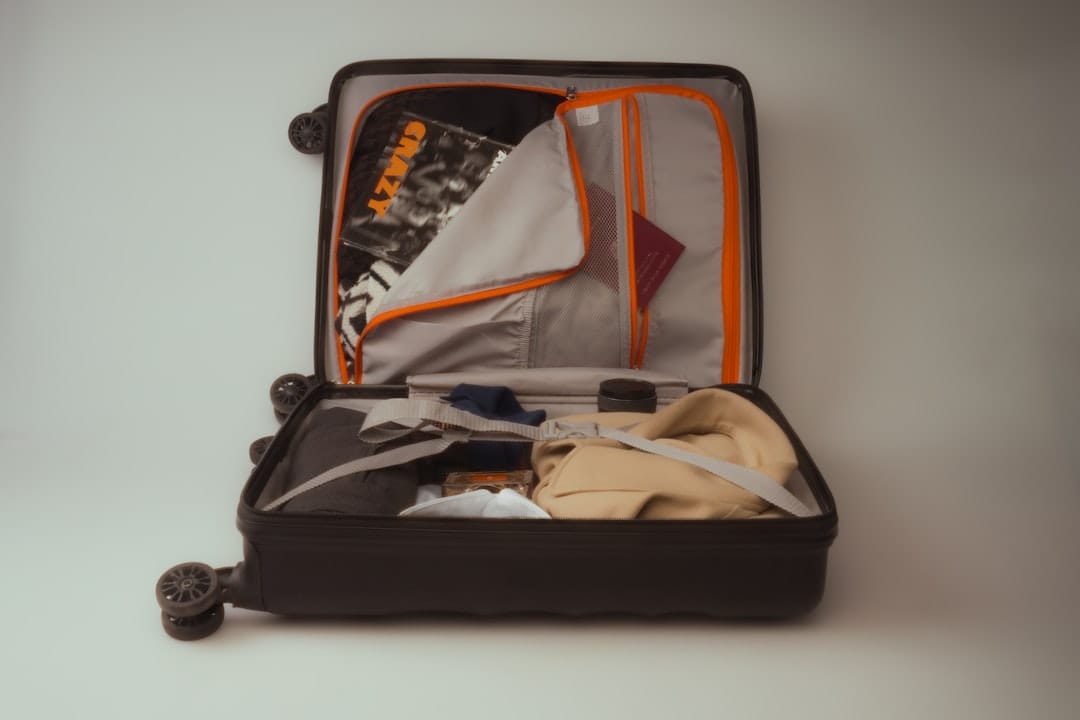
Master the Fold (and Know When to Roll)
The first and most enduring debate in packing is fold versus roll, and the honest answer is that you need both. Rolling works beautifully for soft, casual fabrics — t-shirts, jersey dresses, leggings, pyjamas. Lay the garment flat, fold it once lengthwise, then roll it tightly from the bottom up into a firm cylinder. Rolled clothes resist creasing, slot neatly into gaps, and let you see everything at a glance instead of digging through a stack. That's trick number one and two: roll your soft layers, and roll them tight enough that they hold their shape on their own.
Structured pieces, though, prefer to be folded. Button-down shirts, blazers, and anything with a defined collar hold their lines better flat. Here's the trick most people miss (number three): use the bundle method for these. Lay your largest, least wrinkle-prone item flat as a base, place the next garment crossways on top, and keep layering until you wrap them all around a soft core like a small pouch of underwear. Folded together as one unit, the fabrics cushion each other and arrive looking pressed rather than punished. And trick number four — flatten everything you can. Squeeze the air out as you go. Air takes up room that clothing should.
Number five: fill your shoes. The cavity inside a pair of shoes is prime real estate, perfect for socks, rolled belts, chargers, or a small toiletries bottle. Slip each shoe into a fabric bag or a disposable cap first to keep soles away from clean clothes, then tuck them along the spine of the case where the wheels live, since that area is already reinforced and slightly recessed.
Compress, Compartmentalise, Conquer
Compress, Compartmentalise, Conquer
Feature comparison of compression and organisation tools for maximising carry-on luggage space.
| Feature | Packing Cubes | Compression Bags | Vacuum Seal Bags |
|---|---|---|---|
| Space Reduction | 20–30% | 40–50% | 60–70% |
| Reusability | Unlimited | Unlimited | 5–10 uses |
| Organisation View | Transparent | Opaque | Opaque |
| Best For | Weekly trips | Multi-week tours | Emergency compression |
If there is one investment that changes everything, it's packing cubes — and they earn tricks six through eight. Sort your belongings by category rather than by outfit: one cube for tops, one for bottoms, one for underwear and socks. The act of compressing each cube squeezes out air and turns a loose jumble into tidy, stackable bricks that lock together with no wasted gaps. The bonus is psychological as much as physical — when each cube has a job, repacking mid-trip takes seconds instead of a full unload.
Number nine: graduate to a compression cube or a vacuum-style bag for bulky items like a puffer jacket or a fleece. These flatten a mountain of fluff into a slim panel you can lay along the bottom of the case. Number ten is a quieter discipline — pack a capsule wardrobe built around two or three core colours so every piece works with every other piece. Fewer garments that mix and match means a lighter bag and, conveniently, fewer decisions each morning. That same minimalist instinct serves you well at home too; the philosophy behind a minimalist home office translates almost perfectly to packing — own less, choose better, and everything fits.
Trick eleven: use every hidden pocket your bag offers, and create new ones. The mesh divider lid is perfect for flat items — a laptop sleeve, a notebook, swimwear. The interior corners that always sit empty are ideal for a rolled scarf or a charging cable wrapped around itself. Think of your carry-on as a small apartment: the goal is to use the walls and ceilings, not just the floor.
Enjoying this? Get more like it.
Weekly picks for remote workers and digital nomads — tools, destinations, and honest takes, straight to your inbox.
Subscribe free →
Wear It, Shrink It, Decant It
Some of the most effective space-saving happens before you ever touch the case. Trick twelve: wear your bulkiest items onto the plane. Your heaviest boots, your warmest jacket, the chunky knit you'd struggle to compress — put them on your body and let the airport take the load. A jacket with deep pockets doubles as extra carry-on, swallowing a phone, passport, snacks, and a paperback without counting against your bag at all. Cabins run cold anyway, so you'll be glad of the layer once you're at altitude.
Number thirteen attacks the silent space-hog of every bag: toiletries. Decant everything into small refillable bottles rather than carting full-size containers you'll never finish. A travel-size routine isn't just lighter, it keeps you under liquid limits and frees up surprising volume. Better still, trick fourteen — go solid wherever you can. Shampoo bars, solid conditioner, a bar of soap, and toothpaste tablets eliminate liquids entirely, weigh almost nothing, and never leak across your clean shirts at 30,000 feet.
Trick fifteen is about cables and tech, the tangled nemesis of every remote worker. Wrap each cord into a small loop and secure it with a clip or a hair tie, then store them all in a single slim pouch rather than letting them snake loose through the bag. A dedicated tech pouch keeps your chargers from eating space and, more importantly, from never being found when you need them at a boarding gate.
Pack Like You'll Repack — Because You Will
The final tricks are the ones that separate the occasional traveller from the seasoned nomad who lives out of one bag for months. Number sixteen: pack in layers of weight, heaviest at the base near the wheels and lightest at the top. This keeps your centre of gravity low so the bag rolls smoothly and doesn't topple, and it protects delicate items from being crushed under a stack of denim. Think of it as building a little wall — foundation first, fragile things up high.
And trick seventeen, the one that quietly makes all the others sustainable: leave room. It sounds counterintuitive after sixteen tricks devoted to cramming more in, but a carry-on packed to bursting on day one has nowhere to absorb the souvenir, the laundry that didn't dry, the gift someone hands you on your way out. Aim to fill about eighty-five percent and keep a compressible buffer. The discipline of travelling light pairs naturally with the discipline of travelling slowly — and if you're drawn to staying longer in fewer places, you'll find that mindset rewards you in our guide to slow travel cities for nomads on a budget.
Settling into a place for weeks rather than days also means you'll repack less often and lean on local laundry instead of hauling a fortnight of outfits — a small shift that quietly halves what you need to carry. The same goes for choosing the right base; thoughtful accommodation choices with a kitchen, a washing machine, and a desk reduce the gear you have to pack in the first place.
None of these seventeen tricks is complicated on its own. Rolled tees, a bundle of shirts, three packing cubes, a pair of stuffed shoes, solid toiletries, your jacket on your back, and a little breathing room — together they transform a stubborn, overstuffed carry-on into a calm, ordered space where everything has a home. The first time you breeze past the bag-drop queue and step straight to security, you'll understand why the people who travel most travel lightest.
So before your next trip, lay everything you planned to bring on the bed, then quietly remove a quarter of it. Roll what's left, compress it into its cubes, and zip the lid shut with one hand. The room was always there — you just needed the right tricks to find it.